Introduction: The Dawn of AI-Driven Software Development (2026 Edition)
The past two years have been more fundamental to software development than the past two decades. The mentioned shift started in 2025, and in 2026, the AI agents came into the limelight. And they are no longer assistants. Information technology is very popular in India and around the world. Everyone is talking about how engineering teams are being reimagined through the use of smart automation.
AI agents are codes that perceive actions, decide on them, and perform them without near-human interaction. They are not instruction followers. They solve problems using natural language processing, machine learning, and automation. They optimize work processes across automation, debugging, deployment, security, and sustained innovation.
The main concept of this new era is straightforward. Intelligent AI agents cease to be tools; they are digital partners. And this is changing the landscape of the AI agents software development in a way hardly anybody would have imagined.
We shall discuss how these agents are defining the new engineering scene.
What Are Smart AI Agents in Software Development?
Smart AI agents are intelligent systems. They are autonomous and are meant to carry out development activities throughout. They developed from simple coding aids to being complete decision-making partners. The previous tools, such as GitHub and Copilot, were strong autocomplete systems. Yes, it is helpful, but limited. They would make proposals and fail to implement them.
But AI agents are different.
They are able to comprehend the circumstances of a project. They track goals. They don’t need supervision. They are able to devise tasks, break down tasks, and revise and rectify errors.
The difference between the AI tools and the AI agents exists.
• AI tools assist.
• AI agents execute.
They use NLP, ML, and automation to make intelligent decisions. They can:
• Perform operations without human intervention.
• Get knowledge by learning past code commits.
• Incorporate with CI/CD pipelines for continuous work.
Concisely, they are the latest labor force in the AI software development agents.
The Rise of AI Agents for Developers
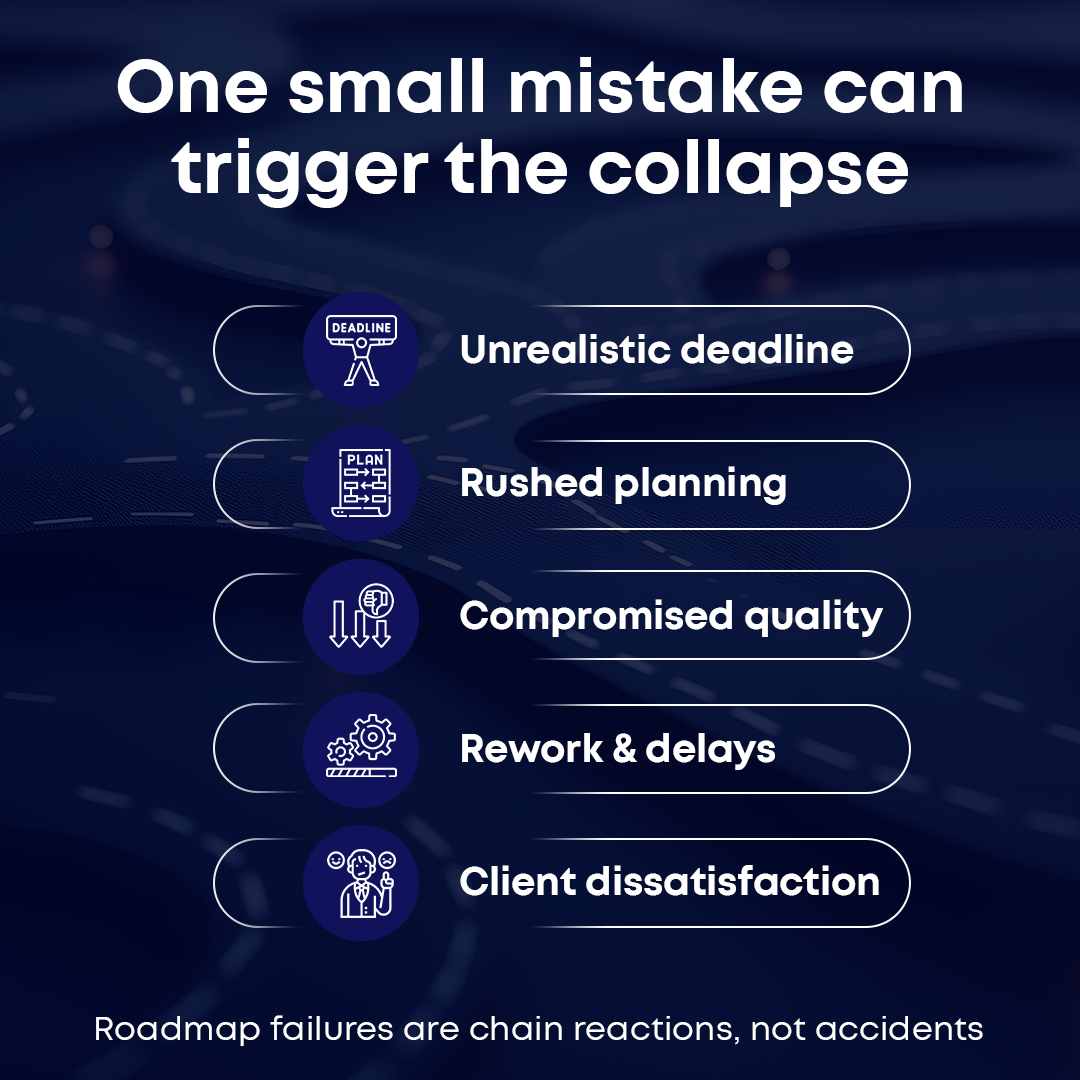
The 2026 AI agents become virtual team members. They not only facilitate the developers; they collaborate with them. This change is evident in technology centers in Bengaluru, Hyderabad, Pune, Silicon Valley, Singapore, and Berlin. Developers experience the change in their daily coding practices.
Here is what they do:
• Write and review code
• Create documentation automatically.
• Manage version control
• Run testing cycles
• Recommend architecture modifications.
The recent 2026 trend reports reflect an incredible revelation: 40% of the time spent by developers debugging has been reduced thanks to intelligent AI coding assistants.
Teams adore them because they minimize manual effort. Their advantage to the managers is that they are faster to deliver. And developers treat them as actual teammates and communicate with them via messages, tasks, or voice queries.
This advanced cooperation is an excellent demonstration of the real strength of AI agents for developers.
Key Benefits of Using Smart AI Agents in Development
The smart AI agents have value in four key areas.
• Speed and Productivity
It takes a project that may have taken weeks to a few hours. Code fixes, feedback, and automated testing for fast delivery. Teams are able to go through the idea of deployment even faster.
• Quality Improvement
AI agents identify code smells, logic errors, and security risks. They search through the whole repositories and identify problems that are missed by humans. What results is more stable, safe, and cleaner code.
• Cost Reduction
AI minimizes the total development costs by reducing human errors and expediting delivery times. Firms incur less time in rework and use fewer resources in duplication.
• Innovation Acceleration
Programmers are now concerned with thinking, imagination, and planning, and not with typing. This boosts innovation. Teams experiment more. Products grow smarter.
This is the actual force of the AI agents software development.
How AI Agents Are Revolutionising Each Stage of Software Development
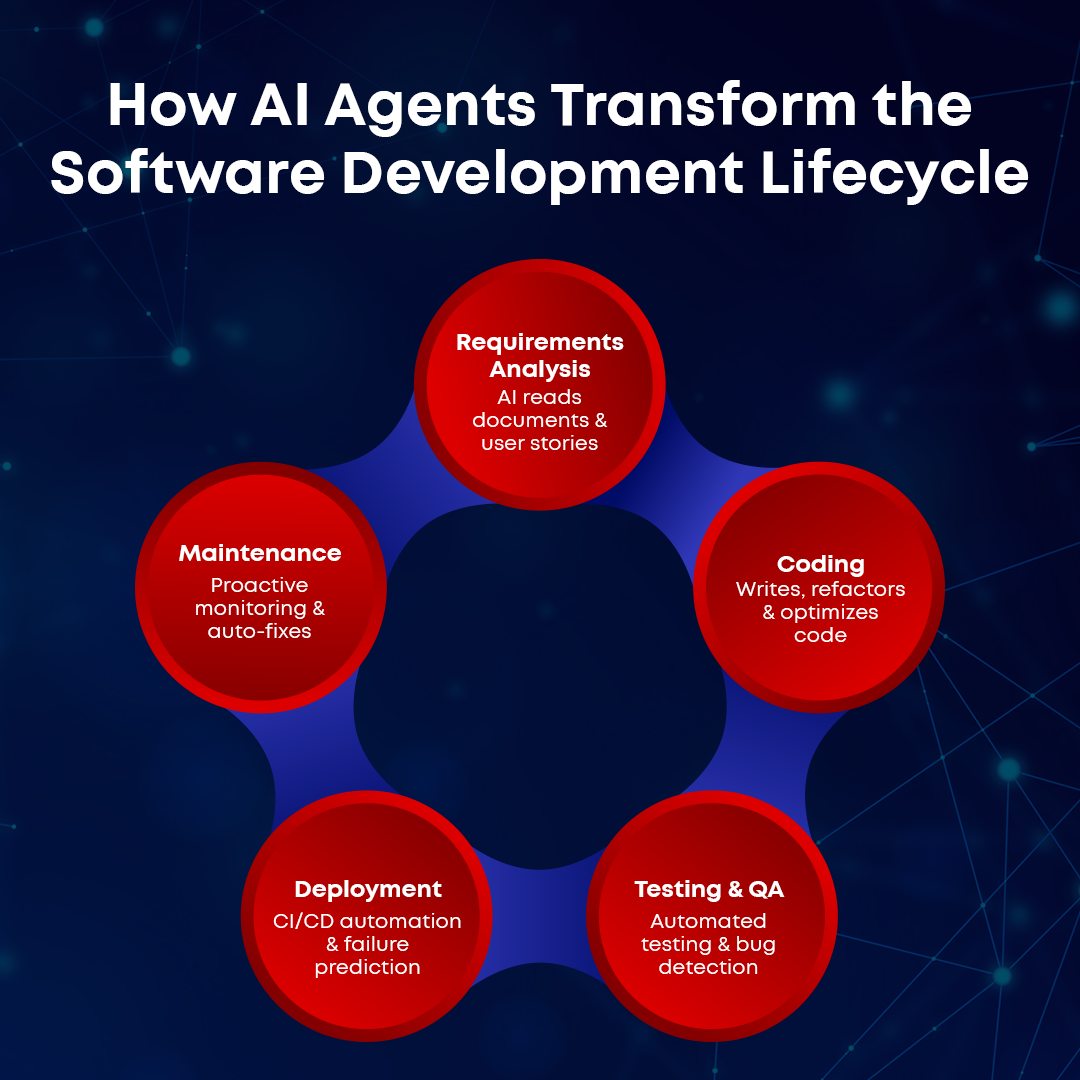
The whole software development life cycle is evolving. That is how the AI agents change every step.
-
Requirement Gathering
AI agents read papers submitted by clients, understand user stories, and find explicit requirements. They use NLP to elevate the issues and suggest the changes. This facilitates the effectiveness of teams.
-
Coding Phase
Agents write code, rewrite old modules, and optimize functions. They are uniform in naming, formatting, and improving performance.
-
Testing & QA
They produce test cases, simulate, and find bugs in real time. They specify possible failures prior to their exposure to the users.
-
Deployment
AI agents offer this service of constant delivery. They abide by dependencies, trace pipelines, and perform predictive analytics in a bid to prevent deployment failures.
-
Maintenance
They anticipate issues ahead of time. Automatic fixes are implemented. They keep track of records and keep systems on winning terms.
This is the actual revolution of AI agent software development, and it is expanding.
AI Agents and Software Security Risks
Along with autonomy, new dangers arise. Since AI agents act without supervision, it increases the issue of cybersecurity. Teams must stay alert.
Common risks include:
- Data exposure – Sensitive information can be accessed by the agents.
- Malicious code injection – There is a possibility of misuse of agent prompts by attackers.
- Biased decision-making – Defective training data can influence the quality of the codes.
But there is a positive side. The security is also reinforced by AI agents. They recognise danger sooner than man. They search for vulnerabilities in real time. They monitor abnormal activity through systems.
By 2026, new security structures will be coming into being to regulate conscientious AI applications. These are standards that guarantee safe adoption as one handles AI agents and software security risks.
Case Studies: How Companies Are Adopting AI Agents (2025-2026)
Startups
Startups are currently using AI agent use cases for startups in India and other parts of the world to build MVPs within the shortest time possible. They employ agents to write, optimize, auto-sprint, and save costs on development.
Enterprises
Large organizations include Agentic AI adoption in enterprises in their CI or CD pipelines. They have confidence in agents in terms of deployment, monitoring, and speed of rollback. Productivity, according to teams, has doubled in most cases.
Open Source Communities
Open-source communities work with AI agents in open-source ecosystems to enhance libraries and experiment with new features. Agents in communities are trained on common datasets, accelerating the pace of innovation within the ecosystem.
These practical examples demonstrate the lightning-fast increase in the development of AI software agents in industries.
The Future of Software Development with AI Agents: What 2026 and Beyond Hold
The future is clear. AI agents will leave the assistance to complete autonomy. They will deal with complete development cycles, including planning to deliver. The teams will treat AI agents as they do their human colleagues.
AI agents will:
• Handle timelines
• Assign tasks
• Suggest architecture plans
• Coordinate Dev, QA, and DevOps.
• Operate live systems using AIOps.
The combination of AI with DevOps is transforming into an AIOps revolution. The first development of AI companies is coming up. Ethical issues will also increase with the increase in autonomy.
Will AI substitute developers or remake their roles?
Developers would not be replaced. Instead, the following things will happen.
• Man will emphasize strategies, decisions, and product thinking that are creative.
• Execution partners will be AI agents.
And this is the real future of software engineering using AI agents, which is a harmonious blend of human creativity and machine accuracy.
This is the trend of the future of software development with AI agents in 2026.
Challenges and Limitations in Smart AI Agent Development
Although the fast development has been achieved, there are still challenges.
-
Dependence on quality data.
AI agents need homogeneous and clean training data. Otherwise, they produce poor outputs.
-
Less knowledge of business
AI has the capability of writing code, but does not necessarily comprehend domain-specific rules.
-
Bias and hallucination
The agents sometimes produce incorrect code. Human verification remains significant.
-
Need for governance
In 2026, there is a high demand for compliance and AI governance. Trust requires responsible use.
Such restrictions teach us that smart AI agent development is yet to be advanced.

Preparing for the AI-Driven Future: How Developers Can Stay Relevant
New talents are required by the developers in order to be ahead.
• Reskilling in AI implementation.
Get to know how to incorporate AI into workflows. Know the way agents think, the manner in which they learn, and the way they decide.
• Prompt engineering
The ability to converse with AI agents has become one of the essential skills.
• Focus on soft skills.
Creativity, communication, critical thinking, and ethics are now more important than ever.
• Develop AI-friendly processes.
Organizations have to establish a workplace in which human beings and AI can work harmoniously. Automation should not be something that a team battles, but it should be adjusted to it.
This assists organizations in optimizing AI agent software development.
Also Read : Is AI the Future of Web Development? Anthropic’s India Launch Says Yes!
Conclusion: The Human-AI Collaboration Era
We are entering a new chapter. It is one of the chapters where humans and machines build software. Smart AI agents will not substitute the developers. They will amplify them. They will replace monotonous activities and provide room for the engineers to think, innovate, and create.
The future lies in teams where machine precision will be combined with human intuition. This alliance is the biggest generation shift.
Do you desire to build AI-driven agents in 2026?