
Introduction – The Harsh Truth Behind Software Roadmap Failures (2026 Insight)
Software roadmap failures are one of the biggest reasons why IT projects fail in 2026, despite skilled developers and modern tools. More than 67% of software projects fall behind or fail to meet their deadlines, a trend that continues to rise across Indian and global IT teams. Interestingly, the root cause is rarely poor coding. In most cases, the real issue is poor planning and lack of structured project management, as highlighted by key project management statistics.
The software roadmap is a high-level and simple way of writing down what you want to develop and why you want to build it. It also helps to know when you hope to release it. Consider it as the connection of your vision to your implementation. The teams use it in order to remain on track and release features in time. It also minimizes confusion.
This is the problem though. Most of the software roadmap strategies end up failing halfway. This translates to a time wastage that is costly and dissatisfied customers. It also leads to under-over-stressed teams and frustrated management. The cycle is repeated in many companies.
Why? The reason is that the roadmap appears ideal on a presentation slide but fails miserably during implementation in the real world.
We shall deconstruct the reasons software roadmaps fail and the common software roadmap mistakes. We will also discuss the successful software roadmap approach employed by future-ready teams in 2026. Let’s dive in.
What Is a Software Roadmap, and Why Does It Matter?
A software roadmap is a strategic map that gives the list of what your team is going to build and in what sequence you will make it. It assists leaders and developers. It also helps designers and testers. It helps clients in realizing the bigger picture.
A roadmap matters for the following reasons.
• It settles business vision against engineering priorities.
• It helps startups develop at a quick pace but remain focused.
• Long-term product cycles are handled by Helps enterprises.
It helps CTOs become effective communicators.
A robust software roadmap strategy offers some clarity, structure, and footing. It assists the teams to say ‘yes’ to those things that are important and ‘no’ to needless work. A prepared software roadmap guide will be an instrument of improved decision-making.
Despite all these advantages, most teams fail to get their roadmaps to work.
Let us understand why.
The Hidden Reasons Why Software Roadmaps Fail
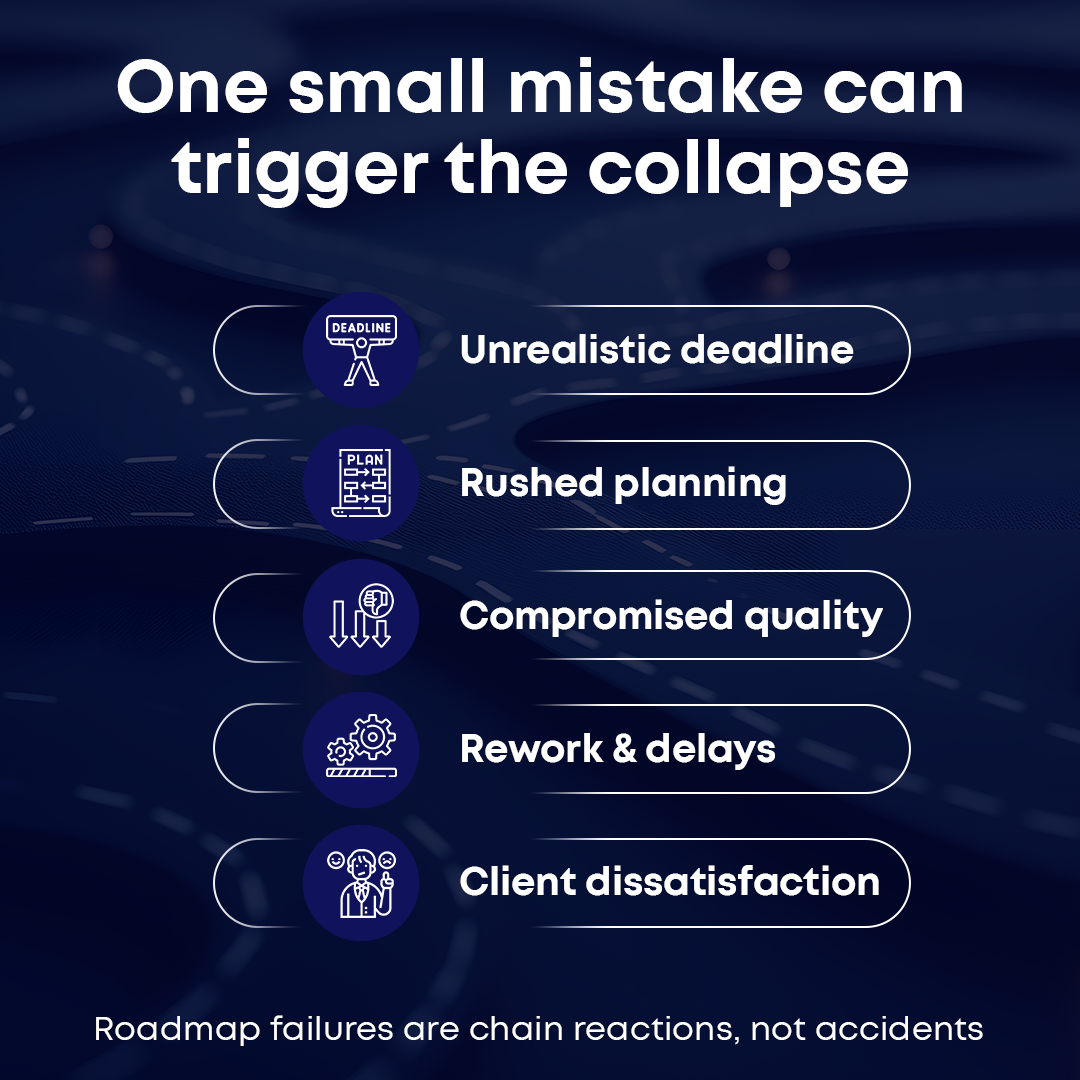
1. Unrealistic Timelines and Scope Creep.
Most software projects fail to succeed since they are made up of timelines. It appears good on paper. It is common to have a leadership that desires something to be delivered quickly. Also, developers need time to understand real-world technical issues. These incongruencies result in strain, compromises, and deadline failure.
The problem is aggravated by scope creep. A client is a simple addition of a feature. One of the top managers makes a minor improvement. And before you realize it, your original roadmap does not apply anymore. An industry report published in 2025 established that only 31% of software projects are completed on time and within budget. It attributed much of the shortfall to poor planning and scope issues.
This is considered to be one of the largest causes of software roadmap failures.
2. Lack of Stakeholder Alignment
A roadmap fails when the business leaders, tech leaders, developers, and clients differ in their thinking on where the product is headed.
- Leadership wants speed
- Developers focus on quality
- Clients demand new features
When everybody is pulling the roadmap in opposite directions, the plan falls apart. Misalignment causes delays and frustration as well as conflict.
The best strategy may even fall apart without alignment.
3. Ignoring Dependencies and Technical Debt
The other frequent software roadmap error is the neglect of technical debt and software dependencies on the back end.
• Teams often underestimate
• Legacy code issues
• API limitations
• Infrastructure changes
• Database migrations
• Integration risks
This leads to developmental stop and go.
The roadmap, which fails to factor in these dependencies, is the same as constructing a house without examining the foundation. At some point or another, something breaks.
4. Static Plans in a Dynamic Market
Markets change fast. The expectations of the customers change. Competitors move quickly. Technology becomes outdated in a few months.
When your roadmap is strict, you will be left behind.
Stagnant roadmaps develop significant software planning issues as the roadmap is unable to change with new information. A roadmap should be able to change and not be set in stone. Otherwise, teams waste time creating features that no one desires to see anymore.
5. No Clear Ownership or Progress Tracking
The failure of many teams is attributed to the fact that the owner of the roadmap is unclear. Whenever no one is responsible, issues arise and increase.
• Missed deadlines
• Slow approvals
• Confusion about priorities
• Poor communication
Much research discovered that ambiguous ownership is one of the most common reasons for failure to deliver in tech teams. The lack of visibility and tracking is a precondition for software roadmap failures.
Also Read This – How Agile Software Development Life Cycle Is Shaping Software Projects
The Proven Software Roadmap Strategy for 2026
To ensure the survival of your roadmap in the face of real-world challenges, take this future-ready strategy.
Step 1 – Start with Clear, Outcome-Driven Goals
Do not start with features. Start with outcomes.
You can also use the SMART model. It consists of the following points.
• Specific – Be specific about what you want to accomplish without any doubt.
• Measurable – Set specific metrics to measure progress and accomplishment.
• Achievable – Be realistic with the resources.
• Relevant – Fit the goal with business needs and product direction.
• Time-bound – Have a definite time frame to develop urgency and concentration.
Priorities are easier to resolve in case there are clear goals.
Step 2 – Prioritize Flexibility Over Perfection
You should be led by a roadmap, not held back. Avoid overplanning.
Focus on the following points.
• Quarterly goals
• Rolling updates
• Agile sprints
• Buffer time
This makes you acclimatize fast to changes.
Identification of a future-ready software roadmap can be iterative. It is dynamic enough to make changes in line with new market trends or responses.
Step 3 – Use Data and AI Tools to Predict Risks
In 2026, the teams are based on data, forecasting tools, and automation. The AI-powered tools can analyze the patterns, estimate risks, and identify delays prior to their occurrence.
This includes the following points.
• Velocity prediction
• Blocker identification
• Resource planning
• Trend analysis
Even the developers can be automated by the AI agents to get rid of repetitive tasks and enhance accuracy.
This renders the roadmap smarter and more reliable.
Step 4 – Communicate and Iterate Regularly
A road map cannot be kept in a folder. It has to be spread, gathered, adjusted, and refined.
Do the following things regularly.
• Meeting with developers every week.
• Leader reviews per month.
• Quarterly updates according to market and customer statistics.
The more communication is done, the fewer surprises there are.
Step 5 – Balance Short-Term Wins with Long-Term Vision
Minimal victories keep the team going. The long-term objectives make the product scalable.
A good software roadmap strategy achieves a balance between the following points.
• Rapid releases of customer feedback.
• Planning of long-term architecture.
• Strong focus over the 12 to 18 months.
This will help in shaping up teams without burning them.
Software Roadmap Best Practices Every Team Should Follow
The following is the checklist for your convenience.
• Look at your roadmap after every quarter.
• Match the roadmap to business KPIs.
• Clearly see milestones with roadmap tools.
• Make decisions on what to update according to customer feedback.
• Plan for dependencies early.
• Buffer against unknown risks.
• Monitor the progress openly and transparently.
• Make the road map available to all the stakeholders.
It is your easy, practical software roadmap guide to use on a daily basis.
Future of Software Roadmapping – Trends to Watch in 2026

Software planning is a fast-changing world. This is what progressive teams are taking up.
• Artificial Intelligence Agents Predictive Planning.
Teams are now assisted by AI tools to predict the schedule, risk recognition, and dependency planning. This minimizes the mistakes and avoids the failures of the software roadmap.
• Data-Driven Decision Making
Rather than making guesses, user behavior, performance analytics, and market trends metrics guide the refinement of the roadmap by the teams.
• Teamwork through Cloud Tools.
The cloud-based teams enable distributed teams at a single location to interact with those at a different location. This increases performance, coherence, and transparency.
• More resourceful allocation of resources.
Predicting the workload and skill match of the developer, reducing burnout, and enhancing the quality of delivery are some of the objectives of the tools.

With these trends, roadmap planning becomes more intelligent, fast, and dependable.
Conclusion – Turning Roadmap Failures into Future Success
Software roadmaps have a high failure rate because they are either impractical, inflexible, or not tied to real-world implementation. Yet, with the correct approach, you can make your roadmap a potent business growth tool. You can maintain focus on objectives and flexibility in planning. You can predict risk using data and artificial intelligence. Also, with open communication, you can track progress against the plan. Always remember that your roadmap is not just a plan but a promise to your users. It is a promise to value rather than a nightmare. Now is the time to get to the next level with professional adviceIf your team is struggling with software roadmap failures, our product strategy experts at Autotroph Infotech help businesses build execution-ready, future-proof software roadmaps.