Introduction
Did you know that 75 percent of businesses the world over are losing millions of dollars every year due to ERP delays and crashes? Payments freeze. Inventory vanishes. We have stopped revenue leaks on high-traffic casino platforms with 100,000 plus users. It is a single sync error that costs a night haul.
ERP failures not only make teams slow in a high-traffic environment, such as the global casino platforms. They cause compliance risks, errors in payment, and scale customer churn. Hours of delay in finance, supply chain, or HR data have already been inflicted.
This is the reason why ERP systems are of critical importance to international businesses. They run finance. They manage people. They move inventory. They determine whether the business thrives or not.
However, the conventional ERP systems were not designed to handle the present data volume and decision speed.
This is where AI in ERP systems is altering the rules.
AI is not an add-on anymore. It is becoming the driving force of automation, intelligence, and adaptability within enterprise platforms. This change is no longer an option for founders, CTOs, and enterprise leaders seeking 2026 tech roadmaps.
AI-powered ERP enables global businesses to operate intelligently, forecast risk, and scale with confidence.
What Are ERP Systems and Why Global Enterprises Depend on Them
Before we talk about how AI is transforming ERP, it is important to understand what ERP systems actually are – and why they are mission-critical for global enterprises.
What are the ERP systems?
ERP stands for Enterprise Resource Planning. But in reality, ERP is not just software. It is the central nervous system of a business.
An ERP system connects and manages all core business operations through a single, unified platform. Instead of teams working in silos with disconnected tools, ERP creates one source of truth across the organization.
A modern ERP system typically manages:
- Finance and accounting
- Supply chain and procurement.
- Human resources and payroll
- Manufacturing and operations.
- Customer management and vendor management.
For global enterprises, ERP systems are not optional – they are essential.
Fragmented systems are a nightmare when you are working in different regions, different currencies, and with different regulations. ERP systems are used to enable the standardization of processes and local flexibility.
But here is the catch.
Conventional ERP systems were created to support foreseeable processes. When data is real-time, unstructured, and massive, they find it to be difficult.
Emails, PDFs, customer behavior data, system logs, and external data feeds are now a core part of how modern enterprises operate. Most of this information does not fit neatly into legacy ERP models. These were designed for structured tables and predefined fields. As a result, valuable insights remain unused. The processes stay manual and decision-making becomes slower and less accurate.
It is precisely that which is where AI comes into the equation.
Why Traditional ERP Systems Are No Longer Enough
A good number of businesses continue operating ERPs that were good ten years ago. However, the scale has changed.
This is where conventional ERP systems fail.
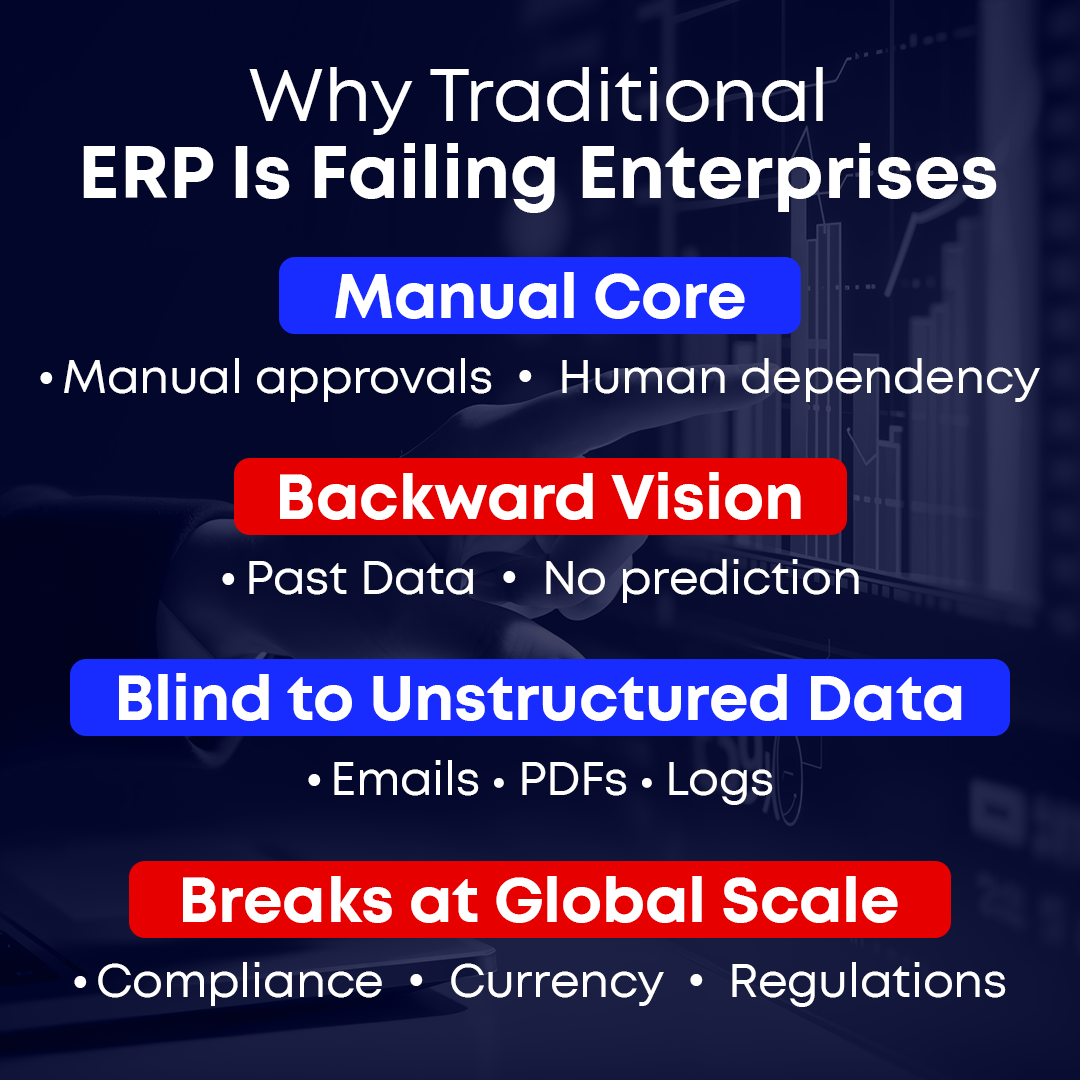
Key processes are characterized by manual workflows : Approvals, reconciliations, and exception handling are still heavily manual in many organizations. Too many critical steps depend on humans reacting only after problems have already occurred, which increases delays, errors, and operational risk.
The reporting process is backward and late : The majority of the ERP dashboards present what has already taken place. Leaders are often not notified of an issue before it has affected revenue or compliance.
Unstructured data is often overlooked : Customer emails, supplier contracts, and support tickets generate large volumes of unstructured data every day. Behavioral data adds even more complexity to manage and analyze. Traditional ERP systems are not designed to process this data at scale. It limits visibility and slows down informed decision-making.
Global complexity breaks rigid systems : Global enterprises must manage multiple tax rules, local labor laws, and constant currency volatility across regions. Static ERP rules do not adapt fast enough to these changes, which increases compliance risk and reduces operational agility.
This situation creates a significant risk for the business. It increases operational risk, exposes the organization to financial risk, and can also damage the brand if issues affect customers or regulators.
The solution is not in additional patches. The solution is system-in-built intelligence.
How AI Is Redefining ERP Systems
This is where the AI in ERP systems transforms the manner in which enterprises are run.
AI does not replace ERP. It upgrades it.
Intelligent Process Automation.
Traditional automation follows fixed, predefined rules that do not change over time. AI-driven automation, on the other hand, learns patterns from data and improves with use.
Systems can deal with ERP automation using AI.
- Systems can anticipate delays prior to their occurrence.
- It signifies exceptions automatically.
- It risks an urgency-based routing.
This is not basic scripting. It is ERP automation, which evolves in line with the change of business.
Predictive analytics and Forecasting.
AI introduces forward-looking intelligence into ERP platforms.
Instead of asking, “What happened last quarter?”
Teams can ask, “What will happen next week?”
AI models analyze trends across finance, inventory, and demand to deliver:
- Demand forecasts
- Inventory optimization insights
- Cash-flow predictions
As a result, decision-making shifts from reactive to proactive.
Machine Learning for Continuous Optimization
Machine learning enables ERP systems to improve continuously over time.
- Every transaction.
- Every exception.
- Every correction.
The system learns from enterprise data on an ongoing basis. As a result, workflows become smarter, recommendations grow more accurate, and errors are reduced without the need for constant manual tuning. This is how ERP platforms remain relevant and effective at scale.
Natural Language Processing (NLP) in ERP
NLP is transforming how teams interact with ERP systems.
Instead of relying on complex dashboards, users can ask questions in plain language, such as:
“What was the reason costs were high in Region A?”
“Show recruiting risks in Q3.
AI can also automatically read and process documents, including contracts, invoices, and compliance files. As a result, data entry becomes faster, more accurate, and far less dependent on manual effort.
This is where AI in ERP systems moves beyond IT teams and into everyday business operations.
Enterprise AI ERP Software: Key Capabilities Global Businesses Need
Not every AI-driven ERP system is enterprise-ready.
True enterprise AI ERP software must support the following capabilities:
Global scalability: Systems should operate consistently across locations, without latency or data silos.
Machine-learning compliance and risk identification : Regulatory risks should be detected early, helping enterprises avoid audit failures and financial penalties.
Cross-department intelligence and data unification : Data should flow seamlessly across finance, HR, supply chain, and operations, enabling unified enterprise intelligence.
Cloud-native architecture : AI capabilities must scale as the business grows.
Security and governance : Explainable AI is critical. Leaders must understand why the system reaches specific decisions.
Reliability, transparency, and control are the cornerstones of enterprise trust.
Real-World ERP System Examples Powered by AI
To understand the real value of AI-driven ERP, consider these industry-neutral examples.
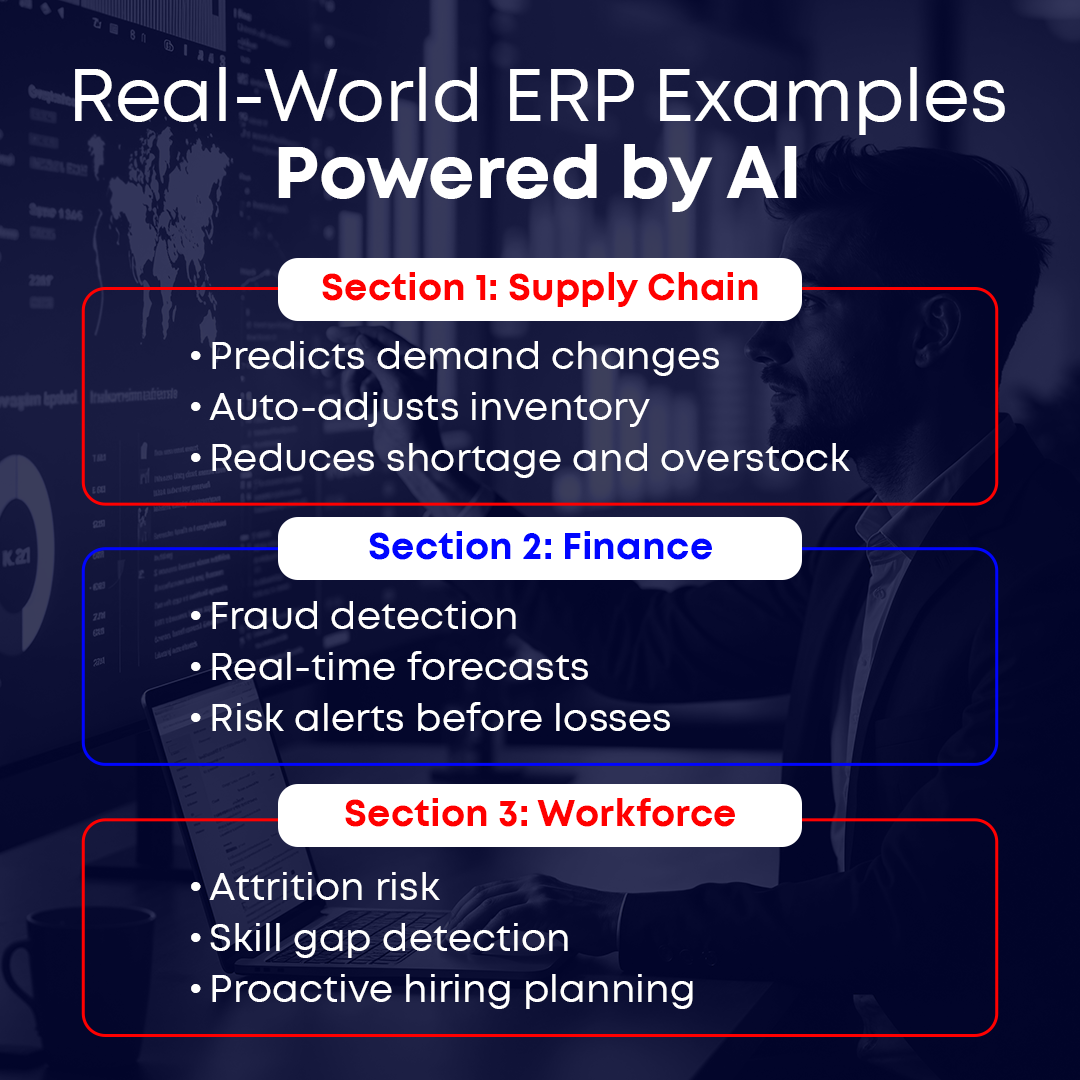
Example 1: Supply Chain Optimization
AI forecasts demand fluctuations and supplier uncertainty. Inventory levels adjust automatically, reducing shortages and overstock situations.
Example 2: Financial Projection and Fraud Detection
AI models detect transactional anomalies and update forecasts in real time. Finance teams can act before losses occur.
Example 3: Workforce Analytics and Planning
AI identifies attrition risks, skills gaps, and future hiring needs. Workforce planning becomes proactive rather than reactive.
These examples show how AI is transforming ERP from a record-keeping system into a decision-making system.
Business Benefits of AI-Driven ERP for Global Enterprises.
The business impact is clear.
Faster decisions
Real-time insights replace delayed reports.
Lower operational costs
Smart automation reduces manual effort and costly errors.
Stronger compliance and higher accuracy
AI-driven controls continuously monitor risk and consistency.
Greater agility
Businesses adapt faster to market uncertainty and regulatory change.
This is not step by step improvement.
It is the resilience of operations on a large scale.
Challenges and Considerations When Implementing AI in ERP
The adoption of AI is powerful, but it is not automatic.
Enterprises must address the following:
Data readiness : The quality of AI depends on the quality of the data it learns from.
Integration complexity : Legacy systems must be capable of integrating with AI models.
Change management : Teams need training and confidence in AI-driven decisions.
Ethical and transparent AI : Bias must be addressed, and explainability must be ensured.
Choosing the right partner is critical. The success of AI-powered ERP depends more on implementation than on technology alone.
How to Prepare Your Enterprise for AI-Powered ERP Transformation
The results depend on preparation.
Start with these steps:
1. Evaluate existing ERP maturity/bottlenecks.
2. Determine high-impact opportunities of ERP automation.
3. Invest in data quality and data governance.
4. Choose AI scale-ready platforms.
This should be prepared as early as 2026, when some enterprises will be planning to hire and invest in technology.
Conclusion
The transformation is already underway. The use of AI in ERP systems is no longer a possibility. It is becoming the basis of the way global-based enterprises are running, competing, and growing.
AI in ERP automation can provide speed, precision, and reliability where the conventional system fails. It makes ERP a business asset. To the founders, chief technical officer, human resource leaders, and enterprise planners, the question is no longer whether AI will transform ERP.
Also Read – Why So Many Software Roadmaps Fail? Proven Way to Make Yours Future-Ready
It is the extent of the readiness of your organization to embrace it. It is the right moment to review your ERP strategy, determine AI readiness, and design intelligent enterprise operations that can be scaled without breaking. The early-movers in the enterprises will be the leaders. The others will have to spend years catching up.