Introduction
In 2025 alone, over 120,000 tech professionals were laid off globally. Yet in 2026, companies are still struggling to hire reliable developers. Product launches are delayed. Engineering teams are overstretched. CTOs are competing for the same limited pool of future-ready talent.
This contradiction has created what many leaders now call the “Tech Layoff Paradox” – layoffs everywhere, but a real tech talent shortage beneath the surface. However, the task of hiring developers is more difficult than ever. Founders are challenging the reasons why positions remain vacant for months on end. CTOs stretch out unstable teams. HR leaders are being pressured to recruit more quickly without compromising on quality.
It is not an issue of resume volume. It is a problem of tech talent shortage 2026, disguised as layoffs. Organizations are reducing staff numbers. However, they are not in a position to employ the developers whom they really require.
This blog describes why it occurs, what is broken in technical hiring nowadays, and how firms should change in 2026 to have a stable and scalable system.
What is the Tech Talent Shortage 2026?
The tech talent shortage in 2026 refers to the growing gap between the number of available developers and the number of engineers who actually have production-level, AI-ready, and scalable system experience.
The Tech Layoff Paradox Explained
Layoffs are headline news, whereas hiring plight is not. But they are very much related.
Why Layoffs Don’t Mean Talent Availability
The majority of the layoffs are not skill-based but are role-based. Whole teams are eliminated to lower expenses. This is not because their skills are not required everywhere.
Example-
A mid-sized SaaS business has retrenched 40 frontend developers. They had worked extended years on internal dashboards that were developed using older frameworks. Meanwhile, there is a different company that hires engineers. They are capable of developing real-time and user-facing systems that process millions of requests. The system also integrates AI functionality and has high-security needs. Paperwise, there exist developers. As a matter of fact, few of them meet the requirement.
A large number of laid-off developers worked on the following points.
- Legacy systems
- Internal tools
- Slow-moving products
Nowadays, the demand is rather specific. Developers are not what recruitment managers are targeting. They are searching for those who can ship, scale and secure production systems.
It is the place where the talent mismatch starts. The number of developers is large. However, a small percentage was able to satisfy the current needs. In this way, layoffs will reduce the skills gaps.
The Real Reasons Behind the Tech Talent Shortage in 2026
It is not a fad in the market. This is a structural shift. The rate of technological mobility has surpassed the rate of hiring model adaptability by a factor, and thus, the tech talent shortage 2026 is foreseen.
Skill Mismatch Is Bigger Than Ever
Demand is sharp and narrow today. The companies desire the following.
- AI-ready developers
- Cloud native engineers
- Backend teams that concentrate on cybersecurity.
- Technology experts
Supply looks very different. The number of over-supply developers in the following areas is too high.
- Outdated frameworks
- Monolithic architectures
- Low-scale applications
This provides a skilled developer shortage, rather than an unemployment issue. Skills are not there, but developers are. The right skills are required in the right depth.
Rapid Tech Evolution Outpaces Learning
Technology is evolving even more quickly than a majority of teams can reskill. AI stacks are developed every quarter. Cloud systems update their major versions on a regular basis. The security threats change every week.
The majority of companies lack the time to train afresh. They need developers who are-
- Production ready
- Comfortable with scale
- Knowledge of real-world failure situations.
This is the reason why there are still hiring problems even after layoffs.
Hiring Challenges Companies Are Facing Today
The issue is no longer the identification of candidates. It is the transformation of the correct ones.
Narrow Hiring Criteria
Job descriptions are broken. These are some of the skills that are required in most positions.
- Expert in eight to ten tools.
- Good at senior-level duties.
- Start marketing with a disciplined approach.
Everything is slowed down by this 10 skills in 1 role approach. Good developers are self-filtering. Average ones apply. This is among the largest challenges in the current hiring.
Location & Remote Hiring Complexities
Remote recruitment was promised to be fast. Reality added friction. The challenges to which teams are exposed are as follows.
- Time zone gaps
- Legal and compliance issues
- Communication delays
- Culture mismatch
The remote hiring complexity is not imaginary. Remote does not mean easy. It means different problems.
Longer Hiring Cycles = Lost Talent.
Top developers do not wait. Offers are taken and accepted speedily. In instances where hiring cycles become long, the following occurs.
- Candidates drop
- Offers lose relevance
- Teams stay understaffed
This is a silent revenue risk.
Global Tech Talent Shortage vs Local Hiring Reality
Paper-wise, global hiring ought to be the solution to all problems. Practically, it preconditions new restrictions.
Why Global Hiring Hasn’t Solved the Problem
The same top 10 percent is being pursued by everyone.
- Enterprises
- Startups
- Product companies
- IT service firms
This brings the following problems.
- Salary inflation
- High churn
- Retention risks
The global tech talent shortage is not geographical. It is about experience depth.
Emerging Markets ≠ Instant Solutions
The emerging markets provide size but not immediate preparedness.
The common gaps involve the following.
- Minimal experience with large-scale systems.
- Weak QA processes
- Irregular documentation standards.
Quality becomes compromised without a good onboarding and review system. This contributes to tech hiring challenges rather than remedies.
Why Developer Hiring Is Especially Hard in 2026
Developers have changed, too. They have stopped being applicants, and they are now turning into evaluators.
Developers Evaluate The Companies
Powerful engineers pose the following tough questions.
- Is the tech stack modern?
- Will I learn here?
- Is engineering respected?
They will not choose the businesses that has the following issues.
- Frequent layoffs
- Short-term thinking
- Broken processes
This has a direct influence on the developer hiring outcomes.
Trust & Stability Matter Post-Layoffs.
Trust is weak following mass layoffs. The following things are desired by developers.
- Stability
- Clear roadmaps
- Long-term vision
Firms that are strategic in cutting suffer their employer brand. And mending trust is time-consuming.
Impact of Tech Hiring Challenges on Business Growth
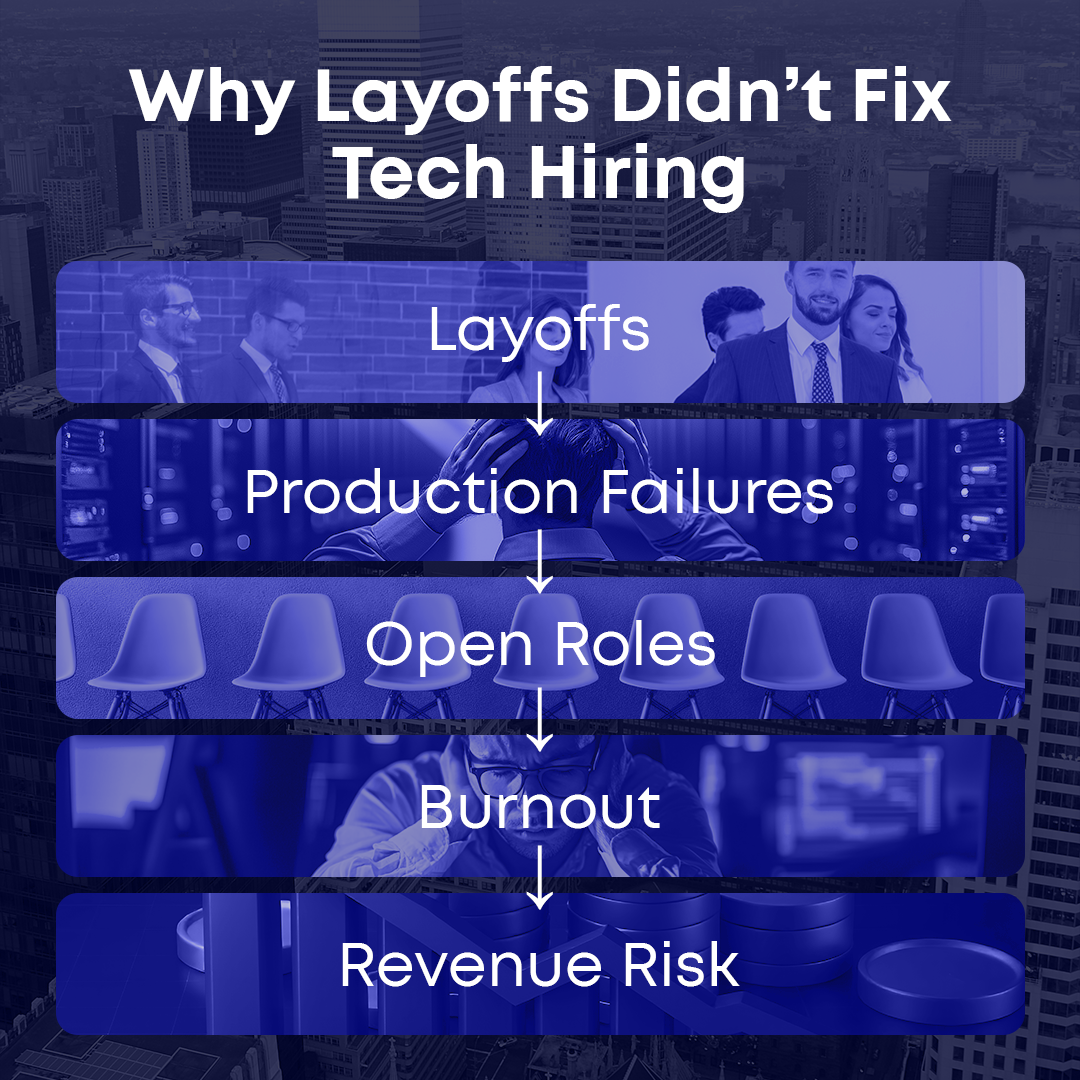
Recruitment issues do not remain in HR. They hit the business.
Delayed Product Launches
The delays of the missing key engineers are as follows.
- Features
- Integrations
- Market entry
Competitors move faster.
Increased Technical Debt
Under-staffed teams are short-cutters. Debt compounds silently and bursts out when on a scale.
Burnout of Existing Teams
Extra load is passed on to high performers. Burnout increases, and attrition comes after.
So, why does it matter? The issue of hiring has a direct influence on revenue, innovation, and scalability.
How Smart Companies Are Adapting to Hiring Challenges in Technology
The most successful teams have ceased to pursue resumes. They restructured the way they create teams.
Skill-Based Hiring Over Role-Based Hiring
These are the skills that are hired by smart companies.
- Fundamentals of engineering.
- System thinking
- Problem-solving ability
They train for tools later. This will minimize reliance on flawless resumes and will solve the specialized skills gap.
Partnering Instead of Permanent Hiring.
The following are some of the strategies employed by many companies.
- Specialized development teams.
- Strategic tech partners
This permits the following benefits.
- Faster scaling
- Access to niche expertise
- Reduced long-term risk
It is a sensible reaction to hiring challenges in technology.
Building Talent Pipelines, Not Panic Hiring
Leaders are planning. They invest in the following.
- Internal upskilling
- Mentorship programs
- Reengineering of the long-term workforce.
This leads to future-ready tech teams as opposed to an on-demand staff.
Also Read – Tech Talent Shortage? Here’s How Leading Companies Are Winning
Benefits & Risks of Current Hiring Models
There is no perfect model. There are only trade-offs. The main point is to realize what you can win and what you can lose before making such a commitment.
Benefits
The benefits of modern hiring models will be realized when they are designed thoughtfully.
Access to global expertise : Businesses have access to expertise that might not be locally available, particularly in the case of a niche or new technology.
Flexible scaling : The teams may be expanded or contracted depending on the needs of the project without the overhead strain.
When done properly, it can be done faster : Hiring via partners or global teams can help to save much time in delivery with the right structure and ownership.
Risks
Unless taken care of or in a hurry, the same models may give rise to hidden risks.
Cultural misalignment : The performance of teams can be hampered by different work styles, communication differences, and expectations.
Reliance on foreign talent : Internal or offshore teams may make a firm more susceptible in the case of geopolitical, legal, or economic fluctuations.
Knowledge retention issues : Important system knowledge may be walking out as a result of key contributors leaving or the expiry of contracts.
Well-organized moderate methods are likely to be effective. Radical or reactive hiring judgment normally does not hold water.

What This Means for the Future of Developer Hiring
The rules are changing.
- The process of hiring will not be resumed first, but skill first.
- The assisted screening of AI will increase.
- The demand for future-ready developers will exceed supply.
The tech talent shortage 2026 will not fade away. However, firms can outsmart others. Investors in smarter models of hiring will ship faster and fail less.
Conclusion: Hiring Fewer, Smarter Developers Is the New Strategy.
Layoffs did not solve hiring. They exposed the pre-existing failure, and alignment is the issue.
Quality-oriented teams will be victorious. Resume-hunt teams will not perform well. The future of the companies lies in the reconsideration of hiring developers, a real-world overview of hiring challenges, and the creation of scale-oriented teams that are not based on shortcuts. Bad hiring decisions today will lose market share in 2026-2027.
Need to optimize your tech staff without the hassles of hiring? Explore smart development partnerships or consult our experts.
The right team is not the biggest one. It is the one that holds when traffic spikes and money is on the line.